Tuesday, February 12, 2019

When a Pulp Franchise Grew Up: The Empire Strikes Back (1980)

 https://upload.wikimedia.org/wikipedia/en/3/3c/SW_-_Empire_Strikes_Back.jpg


      Image Copyright Lucasfilm
     
     If I have little to say about The Empire Strikes Back, it is because I don’t think there is much of anything new to say. Its stellar reputation is completely deserved. It is [barring a somewhat awkward line delivery or two apiece from Mark Hamill and Carrie Fisher] splendidly acted. The script, the editing, the soundtrack, the effects, the directing- all are top-notch, or nearly so, and it functions as a perfectly natural extension of the original film, both deepening it and providing a solid foundation for subsequent installments. And of course, if at all possible, the pre-1997 edition is the one to watch. While it is the least tampered with of the original trilogy in its various post-1997 iterations, practically every single change is both unnecessary and distracting [and many of them create visual continuity errors that did not previously exist].
     In short, the late Irvin Kershner and his team really did make an even better sequel to an already great film. They made the best Star Wars movie to date [not because it’s the most morally grey or thematically dark anything, as is sometimes claimed (although it has such elements), but because it is the most solidly executed of the bunch]. Nothing more needs to be said.

Actual Quality: 12/12
Personal Enjoyment: 12/12

Friday, April 13, 2018

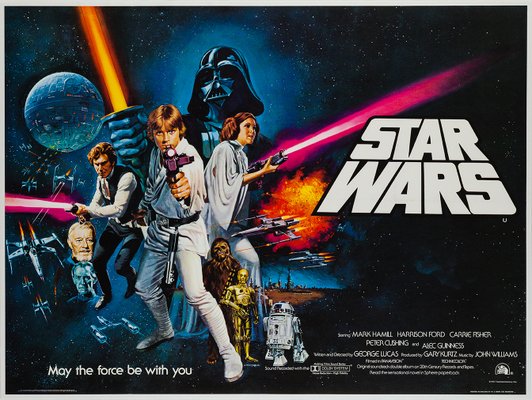
Joyous Pulp: Star Wars (1977)


https://cdn10.pamono.com/p/g/2/1/219468_7jynrgeply/star-wars-poster-by-tom-chantrell-1977-1.jpg 
 [Image Copyright Lucasfilm]

     So much ink has been spent, so many pages written, addressing the origin and creation of the film known known today as A New Hope that I scarcely need spend the time doing it again. Everyone knows of it, for together with 1975’s Jaws, it basically invented the modern summer blockbuster. Suffice it to say that it is one of the most important movies ever made, and anyone with any interest whatsoever in film ought to see it at least once in their lives. Whether they enjoy it or not will, of course, depend on the viewer. Although to be honest, one would have to possess a truly joyless soul not to crack even a hint of a smile at George Lucas’s little space movie.
     The plot of A New Hope -or Star Wars as it was originally called, and as I shall refer to it hereafter- is [or ought to be] so well known to moviegoers that I need not summarize it here. Instead, I’ll proceed straight to my thoughts on how well it holds up.
     Star Wars definitely resembles a product of the 1970s in a number of ways, from the hair to the “used future” aesthetic. Its mentality, however, is far more timeless. Simply put, this movie is what happens when Flash Gordon meets a fairy tale fantasy. Much has been made of George Lucas’s attempt to replicate Joseph Campbell’s theory of the Monomyth on the screen. While there’s something to be said for Campbell being a factor, in the case of this first film at least, old movie serials loom larger as an influence. Even more than that, however, is the fact that Star Wars eschews virtually any and all political and cultural allegories/messages beyond the most generic of “freedom versus tyranny” themes. Instead, it opts for broad themes of heroism, self-sacrifice, and the maintenance of old, time-honored spiritual and cultural traditions in order to preserve all that is good. In the wake of such contentious events as the Vietnam War and the Watergate Scandal, the optimism and fairy-tale-like atmosphere of this film were like a breath of fresh air. Here, at last, was a movie that everyone could get behind, a film that thumbed its nose at the cynicism of the decade and said “no thanks”.
     Yet Star Wars -that little space movie with the clichéd “rescue the princess and destroy the dragon…er, Death Star” narrative- that movie has endured for more than forty years. Why? A whole book could be written to answer that question. For the purposes of this review, suffice it to say that the generalities of the film’s themes, characterization, and narrative have helped it to outlast so many of its contemporaries. Star Wars was made in the 70s, but it transcends the 70s.
     For my money, however, the biggest reason the movie works at all is its total lack of irony and metanarrative. On the surface at least, it really is a preposterous movie. The special effects were excellent for their time, yes, and there are some good performances here [although Mark Hamill is fairly creaky; he wouldn’t improve until later]. However, the film is completely, utterly sincere in everything it does. Never -not once- does it try to be hip, ironic, or “relevant”. There is no clever metanarrative about society to be found here. Star Wars is exactly what it appears to be on the surface, and it is totally unashamed to be so. Not only that, but it is very good at being exactly the kind of movie it wants to be. That is enough.
     The same sort of people who hated Star Wars at the time are the same sort of people who hate it now. Let them, I say; it is their loss. George Lucas’s little space movie is more countercultural than ever before in its resolute refusal to be countercultural. While there is certainly a place for other sorts of films, Star Wars is, frankly, the kind of movie we need now more than ever. And it will endure when all of the hip, post-modern, ironic deconstructions of everything that it stands for have faded into oblivion.

Actual Quality: 11/12
Personal Enjoyment: 12/12

Monday, January 15, 2018

Upcoming Review Series: Star Wars

For all two of the people who bother to read this blog- my apologies for the long absence. I've had a very busy life. But now I'm back, as you see.

In light of the recent release of Star Wars: The Last Jedi, about which I have some...strong feelings, shall we say, I've decided to do a review series of each and every one of the Star Wars films, in order of release. For this series, I will be focusing exclusively on the theatrically released installments. This means that I will not be addressing the infamous Holiday Special or either of the Made for TV Ewok films. Nor will I be discussing any of the various animated series, for the blatantly obvious reasons that they are TV series, not films. I will be reviewing the 2008 pilot film for the CGI series The Clone Wars, however, because it was released in theaters.

 Star Wars fans are an opinionated bunch, and I'm no exception. However, I do pride myself on my opinions being my fully own, irrespective of whether they line up with the majority. Some of my views may be what you'd expect, but others may not be. If I wind up slaughtering any of your sacred cows in the process, I make no apologies for doing so. I've had more repeat viewings of these films than is probably healthy to hone my opinions, and to counter the inevitable counterarguments. Obviously, you're free to disagree with me to your heart's content. All I ask is that you hear me out and try to understand where I'm coming from before you condemn anything I have to say.

With that being said, please enjoy the reviews as they come.

Monday, July 11, 2016

Well-Assembled Silliness: Independence Day (1996)


 https://upload.wikimedia.org/wikipedia/en/b/bb/Independence_day_movieposter.jpg


                       Image Copyright 20th Century Fox

     Roland Emmerich’s Independence Day is one of those movies that are basically critic proof, in the sense that the most common critiques of it pretty much miss the point entirely. Every time I read anything about the hackneyed dialogue, clichéd characters, and naïve patriotism in this movie, I tend to shake my head. In the case of a movie like Independence Day, these things are, paradoxically, strengths rather than flaws, because they play right into the film’s intended purpose- to be a high-budget throwback to those old, corny mid-20th century sci-fi/disaster stories. Independence Day is the classic alien invasion film to end all classic alien invasion films, hearkening back to Cold War-era fears about malevolent saucer-men from space that have it out for us Earthlings. The movie incorporates nearly all of the requisite clichés, playing them to the hilt with great glee on a bigger budget than most old B-movies; even those who hate the movie concede that the effects are great. [Despite the presence of some CGI, this was basically one of the last gasps of old-school model work in American film, and it remains a wonder to behold.]
     At the same time, Independence Day is a product of the era in which it is made. The Cold War had just ended a few years before, with the United States as the triumphant nation. Silly as the movie’s unabashed American nationalism seems in a post 9/11 world, there really were hopes among some that the demise of the Soviet Union prefigured the permanent ascendance of American -or at least broadly Western- political and cultural values across the globe. Even today, knowing where things have gone since the 1990s, it hard not to feel something upon hearing the movie’s famous “Fourth of July” speech, even if it’s only bittersweet regret for the subsequent real-world demise of the hope and optimism for global unity embodied in President Whitmore’s words.
     Make no mistake, though; the primary attraction here is entertainment, and it’s present in spades. From the ensemble cast of delightfully clichéd and archetypical characters, to the silly one-liners and hilariously improbably situations, Independence Day milks its premise and setting to the fullest, offering viewers ample bang for their buck, so to speak. If you aren’t sold on the idea of the movie’s commitment to silly entertainment before everything else, watching it won’t do anything to convince you otherwise. But if you are, you probably won’t find yourself disappointed.
     Yet as much as the movie emphasizes daft fun, there is a method to its madness. Compared to many action blockbusters today, Independence Day is a model of restraint in a number of ways. For one thing, it has a very good sense of pace, taking its time to build up to the action and thus making the inevitable destruction/battle sequences something to savor. For another thing, it gives the majority of its characters something to do in the plot of some sort. And in yet another stroke of genius, the movie avoids overexposing the aliens themselves, preferring to keep them hidden for the entire first half, and only showing them sporadically throughout the second half. For these and other reasons, Independence Day can rightfully be considered an example of style over substance done skillfully.
     There are issues to be found. For example, a brief sequence at a strip-club is needless in light of the fact that the dialogue already revealed the occupation of the character in question, and it accomplishes nothing more than to be an offense to the eyes. This and a handful of crass comments add nothing of value to the movie, which would work perfectly well without them. Also, the family members of one of the characters feel underwritten, as though several critical scenes with them are missing from the final cut. [The eight-minute longer extended cut goes some way towards fixing this last issue, although the film is mostly the same otherwise.] For the most part, however, Independence Day stands as a well-assembled piece of daft entertainment, one which will continue to delight as long as moviegoers need an escape from reality into a world where a dog can outrun an explosion from a giant ray gun and a nerdy guy with a Mac can join forces with a Marine Corps pilot to fight alien invaders.

Actual Quality: 11/12
Personal Enjoyment: 11/12

Saturday, April 2, 2016

A Well-Crafted Travesty: The Little Mermaid (1989)


https://upload.wikimedia.org/wikipedia/en/7/75/Movie_poster_the_little_mermaid.jpg 
[Image Copyright Disney]
     
     As time goes on, it’s becoming more and more socially acceptable to dislike Disney’s The Little Mermaid. Good thing, too, because as much as I hate arguing with people, I have to say it: I don’t like The Little Mermaid.
     Oh, I don’t wish to deny its landmark status. The film did a lot to make Disney animated films popular again after two decades of features that, while not necessarily terrible in and of themselves, nevertheless failed to capture the same level of love among audiences and critics that many of the animated films produced during Walt Disney’s lifetime had garnered. It’s not hard to see why. For one thing, it harkened back to Disney’s earlier roots in that it was an adaptation, however “Disneyfied”, of a fairy tale, the way Snow White and the Seven Dwarfs was. For another thing, the animation was a notable improvement over the limited, less than fluid visuals that Disney had been releasing since the end of the 1960s. It had much catchier songs than its recent predecessors from the studio. And on top of all that, it played right into the emerging “you go, girl!” sentiments of the time that flourished during the 1990s, and that still exist today. Disney, it seemed, had reinvented itself. And audiences loved it.
     The question of whether any of Disney’s animated films from the 1970s and 1980s are worth a second look is a debate best covered elsewhere. For now, suffice it to say that The Little Mermaid was definitely a turning point for Disney.
     I said that I disliked it. Well, that’s not entirely true. The animation, while it has definitely been surpassed since the film’s release in 1989 [in fact, I’d argue that it was already being surpassed as of the next Disney release in 1990], still holds up pretty well; it’s much, much more fluid and less limited than the animation in a film like The Rescuers. Artistically, it strikes me as a blend of previous Disney animated styles and elements of what was to come from the studio during the 1990s. The songs, while not always my thing, are lavishly arranged, and are indeed quite catchy. I’ll willingly admit a fondness for “Under the Sea” and, to a lesser extent, “Poor Unfortunate Souls”.
     But alas! Where the film falls flat for me is in the categories that I care the most about: story and character. And what a fall it is. It’s not just a matter of the film not interesting me- I actually dislike the storyline. All the criticisms of Ariel being a self-centered, unsympathetic protagonist who’s a bad-role model for young girls are every bit as true as you’ve heard. She wants a man she’s only glimpsed a few times briefly, and she wants him now! [Any objections about her being curious about humans in general are non-sequiturs, in that the film makes Prince Eric the near-total focus of this curiosity.] She strikes a bargain with a thoroughly disreputable individual to get what she wants. And just when the film teases you into thinking that she’s going to learn her lesson, it pulls back, and gives her exactly what she wants. The End.
     There were so many nuances Disney could have inserted into this plot- I mean, if they were going to fundamentally alter the original story by [among many other things] letting the titular mermaid live, why not go all out and add nuance to the “true love” theme that the film’s plot hinges on? Why not give the overbearing father figure more nuance by exploring his motivations, and by letting Ariel learn that, however overprotective he is, he actually means well, or -*gasp*- has an understandable, if somewhat unnuanced, line of thought behind his attitude and actions? [And don’t try to tell me the last scene between them was her having learned to accept her father. She only accepts him -only says she loves him- after he gives her exactly what she wants.] But no, they had to play all the tropes so painfully straight. And the end result is a terrible role-model, who’s held up by the film as a person we’re supposed to root for.
     I’m sorry, but no thanks. For all his faults, my sympathies lie with King Triton- who, incidentally, has the closest thing to a complete character arc of anyone in this film. King Triton changes over the course of the film. Ariel doesn’t. King Triton learns something. Ariel doesn’t.
     Say, why couldn’t this movie have been about King Triton? His daughter is annoying, and her love interest, Prince Eric, is a total snorefest owing to a lack of personality on his part. King Triton would make for a much more interesting protagonist.
     In a movie where the character we’re supposed to root for is so fundamentally unlikeable, I have to latch onto what I can to keep myself engaged. And for what it’s worth, I do like some of the supporting roles. Sebastian the crab and Scuttles the seagull have their charms. Ursula the sea-witch is far from my favorite Disney antagonist, but her voice actress is clearly having a good time hamming it up- and it’s very hard for me to resist enjoying hammy villainy.  As for Flounder, his voice grates a little, but he doesn’t bother me overmuch.
     In the end, however, it’s the animation and parts of the score that are the main attraction for me. And when the storyline, the protagonist, and the message irk me so much, that’s not enough. I’ll never deny The Little Mermaid’s place in movie history. I’ll concede that is quite competently structured, animated, voiced, and scored, despite its lack of nuance in the story and character department. But in the end, I just don’t like it. 
 

Actual Quality: 5.5/12
Personal Enjoyment: 2/12