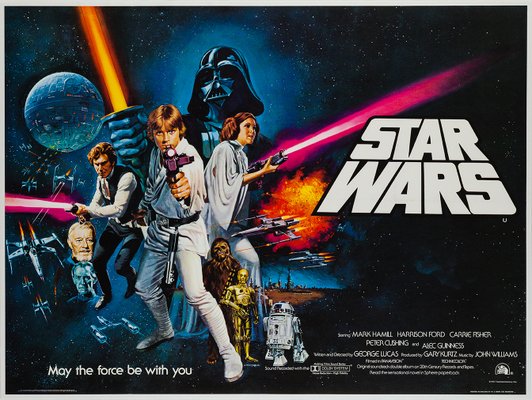
[Image Copyright Lucasfilm]
So
much ink has been spent, so many pages written, addressing the origin and
creation of the film known known today as A
New Hope that I scarcely need spend the time doing it again. Everyone knows
of it, for together with 1975’s Jaws,
it basically invented the modern summer blockbuster. Suffice it to say that it
is one of the most important movies ever made, and anyone with any interest
whatsoever in film ought to see it at least once in their lives. Whether they
enjoy it or not will, of course, depend on the viewer. Although to be honest,
one would have to possess a truly joyless soul not to crack even a hint of a
smile at George Lucas’s little space movie.
The plot of A New Hope -or Star Wars
as it was originally called, and as I shall refer to it hereafter- is [or ought
to be] so well known to moviegoers that I need not summarize it here. Instead,
I’ll proceed straight to my thoughts on how well it holds up.
Star
Wars definitely resembles a product of the 1970s in a number of ways, from
the hair to the “used future” aesthetic. Its mentality, however, is far more
timeless. Simply put, this movie is what happens when Flash Gordon meets a
fairy tale fantasy. Much has been made of George Lucas’s attempt to replicate
Joseph Campbell’s theory of the Monomyth on the screen. While there’s something
to be said for Campbell being a factor, in the case of this first film at
least, old movie serials loom larger as an influence. Even more than that,
however, is the fact that Star Wars
eschews virtually any and all political and cultural allegories/messages beyond
the most generic of “freedom versus tyranny” themes. Instead, it opts for broad
themes of heroism, self-sacrifice, and the maintenance of old, time-honored
spiritual and cultural traditions in order to preserve all that is good. In the
wake of such contentious events as the Vietnam War and the Watergate Scandal,
the optimism and fairy-tale-like atmosphere of this film were like a breath of
fresh air. Here, at last, was a movie that everyone could get behind, a film
that thumbed its nose at the cynicism of the decade and said “no thanks”.
Yet Star
Wars -that little space movie with the clichéd “rescue the princess and
destroy the dragon…er, Death Star” narrative- that movie has endured for more
than forty years. Why? A whole book could be written to answer that question.
For the purposes of this review, suffice it to say that the generalities of the
film’s themes, characterization, and narrative have helped it to outlast so
many of its contemporaries. Star Wars
was made in the 70s, but it transcends the 70s.
For my money, however, the biggest reason
the movie works at all is its total lack of irony and metanarrative. On the
surface at least, it really is a preposterous movie. The special effects were
excellent for their time, yes, and there are some good performances here
[although Mark Hamill is fairly creaky; he wouldn’t improve until later]. However,
the film is completely, utterly sincere in everything it does. Never -not once-
does it try to be hip, ironic, or “relevant”. There is no clever metanarrative about
society to be found here. Star Wars
is exactly what it appears to be on the surface, and it is totally unashamed to
be so. Not only that, but it is very good at being exactly the kind of movie it
wants to be. That is enough.
The same sort of people who hated Star Wars at the time are the same sort
of people who hate it now. Let them, I say; it is their loss. George Lucas’s
little space movie is more countercultural than ever before in its resolute
refusal to be countercultural. While there is certainly a place for other sorts
of films, Star Wars is, frankly, the
kind of movie we need now more than ever. And it will endure when all of the
hip, post-modern, ironic deconstructions of everything that it stands for have
faded into oblivion.
Actual Quality: 11/12
Personal Enjoyment:
12/12

No comments:
Post a Comment